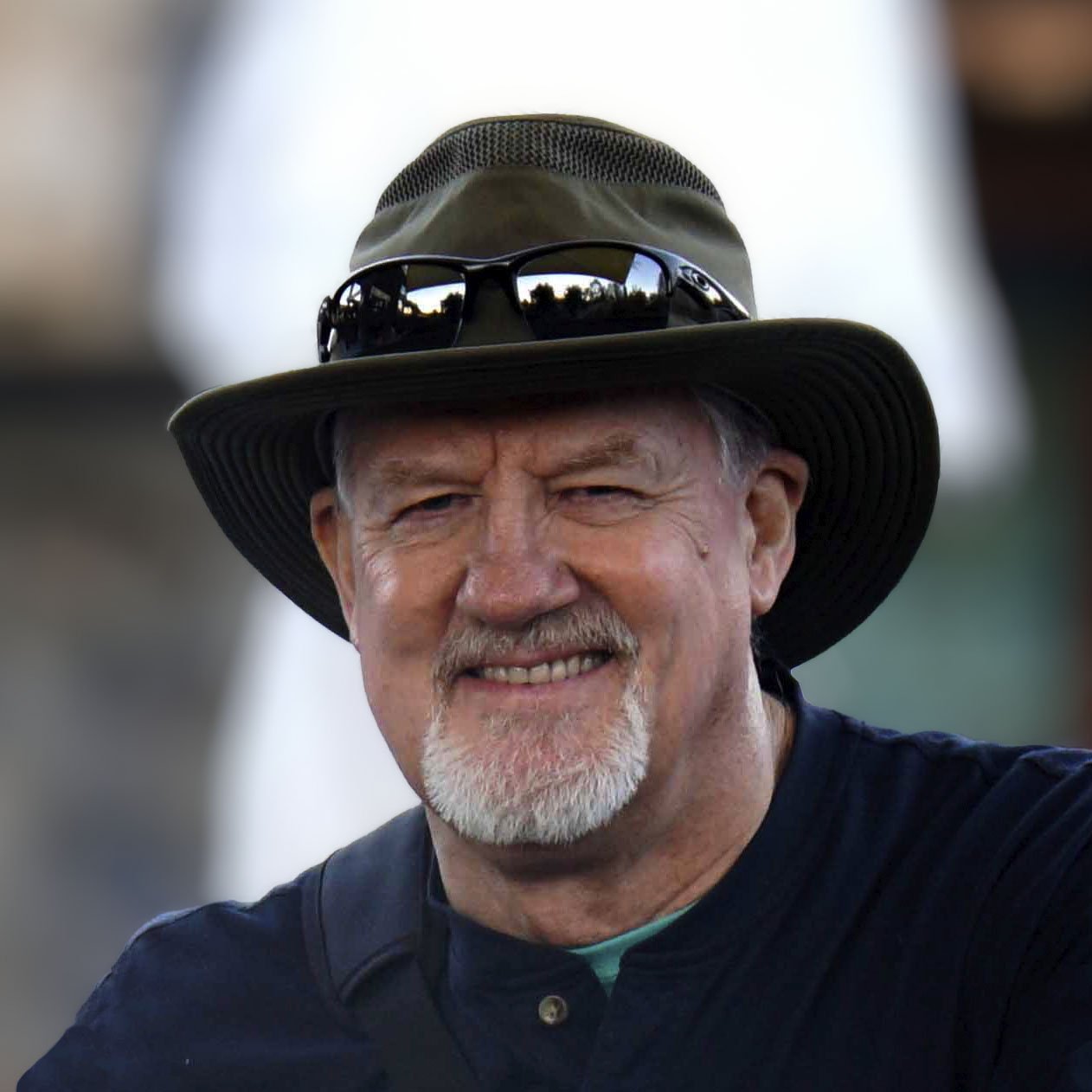
James R. Meyer
Addicted to Art
For my grandchildren, David and Madeleine
This is a thumbnail sketch of my life as an artist - hopefully it will inspire some young (or older) person to pursue art, either as a hobby or a career.
Sorry about the length, but I thought some of the details might be useful to someone.
Early Years
I have loved drawing as long as I can remember. One of my earliest memories was standing at an easel in preschool, making a painting of some kind of war battle, mostly just slashes of red and black and blue all over the paper. In kindergarten through high school, I would sit in class and draw, while listening to the teacher. Curiously, my mind would go quiet and I was able to absorb most of what the teacher was saying. This is “the zone” I experience while drawing - it is like being in a different world. I didn’t have any particular motivation except that I just enjoyed drawing, so I kept at it through the years. I guess you could say I was addicted to art from an early age.
High School and College
I attended summer art classes all through elementary, middle school and high school - I think my mom sent us to summer school to get us out of her hair, but I never complained because it was fun. Later, I took a few college art classes while pursuing a degree in oceanography at the University of Washington. One of my favorite college experiences was making detailed pen and ink drawings of freshly caught marine specimens in the invertebrate zoology lab.
Getting Serious About Art
After college and a stint in the Navy, I decided to take my drawing to a higher level. I rented a basement apartment near Balboa Park in my hometown of San Diego, and bought a book, The Natural Way to Draw by Kimon Nicolaides and decided to work through it from cover to cover. Every morning I went over to the Park and Zoo for about three hours and made quick gesture drawings of animals, people, plants, buildings, and anything else that caught my eye.
The 30-second gesture sketches helped me overcome my fear of failure, of making mistakes. I used the cheapest paper I could find, mostly newsprint and oatmeal paper, from sketch pads to larger sheets. I never saved any of them because I always regarded them as throwaways, something to do for practice.
I also learned another important lesson: if you want to become good at anything, you just keep doing it over and over and eventually you can become as great as you want to be. The key is repetition, experimentation, and learning from others. When you really master a process, there is a thrill you can’t describe - it’s as if the work is completing itself, and it’s coming from somewhere beyond our ability to comprehend.
In the evenings I attended life drawing workshops, where we drew from live models, practicing the other lessons from the Nicolaides book: contour drawing, modeling, composition, light and shadow. It was also great fun to talk with other artists and see what they were doing. I studied drawings of the great masters and even invested in a 4-volume set, Great Drawings of All Time, which I still have. Later, I was exposed to contemporary art and artists, which greatly broadened my horizons.
Art School - Or Not?
After about a year of working on my own, I thought of making a living at art. I figured that if I went to art school I might progress faster and learn how to make money. I enrolled in an MFA program at San Diego State University, where I took courses in advanced drawing, oil painting, watercolors, design, printmaking and art history. However, I soon realized that taking classes didn’t necessarily perform some magic on your abilities, or your chances of making a living as an artist. I quit the program after a year and went back to working on my own, although at a reduced pace.
By then I was 27 years old, and felt I needed to start some kind of career where I could make a dependable income. I also considered attending a really top art school such as the Art Center in Pasadena, although a couple of professionals who graduated from there advised me against it because of the cost. From then on, I treated art as a hobby, simply for the enjoyment of it.
Pursuit of a Hobby
For several years I kept drawing with pen and ink, colored pencils and pastels, and did a few watercolors. Most of this work was with the human figure and botanical subjects, not much in the way of landscapes. I also dabbled in acrylic and oil painting, but never spent enough time to get good at it.
I learned pastels from art teacher Jim Clark at Mesa College in San Diego, during informal life drawing sessions he hosted in the evenings. He was a great artist and teacher, and also a prime example of someone who did “art for art’s sake,” working on discarded pieces of chipboard and as far as I know, didn’t sell any of the drawings he made during our sessions. Of course, he didn’t need the money because he had a regular job :)
Jim Clark was kind of a role model for me as an artist. I could work whatever job to support myself and my family, and in my spare time I could draw and paint to my heart’s content. That suited me quite well, although I realize it’s not for everybody. I have finally realized that I never did art for money, and the only reason I want to sell my work is simply to share it with others.
Landscapes and Photography
My wife wouldn’t allow me to display any of my nude figure drawings in the house, so in 2004 I turned to landscapes. I got my first digital camera and took it on a trip to southern Utah, where I was blown away by the incredible topography there. I had done some film photography before that, but it was so cumbersome and expensive. With the digital camera, I went crazy and shot everything I could see, and learned to process the pictures in Photoshop. Since then I have regularly traveled the southwest, camping and taking pictures of the landscapes. During this period, until 2022, I did photography and almost no drawing or painting. But photography helped me to learn about lighting, color and composition, and I still love it.
Retirement and Digital Inspiration
After a rather tumultuous working life, I retired in early 2019. I was at loose ends for awhile, trying to figure out what to do with all the extra time I now had. Somewhere along the way I had forgotten about drawing and painting, having become totally absorbed in photography. Then in late 2022, I discovered digital art using an iPad, which rekindled my interest in drawing. Now I could make pastels without the mess, and the iPad was so easy to take with me wherever I went.
Painting in Earnest
In 2023, I determined to satisfy my lifelong desire to paint with oils and acrylics. I set up a small studio at home and arranged my schedule to paint about 3 hours every weeknight. As I write this, I’m still learning, but making some progress. I also decided to create this website so I could share my work with others, even if I never sold anything.
If you look at the paintings you’ll see the progression from the earliest paintings in 2023 to my latest ones. I think this is interesting and might give someone an insight into the painting/learning process. I did sort of curate the paintings, selecting some of the better ones for the website, and got rid of the totally failed experiments. My success rate for paintings has gone from about 1 of 3 to about 3 of 5 paintings. By “successful” I mean the paintings worked out somewhat and I liked the results.
More Photography
I haven’t forgotten about photography. In fact, I recently returned from a trip to New Mexico, where I took pictures of the colorful canyons in and around Taos and Abiquiu. I’ll continue to visit the southwest to gather material for my landscapes, using my camera, camping out and enjoying the silence and the beauty of the desert. I also got a drone, and will use it to get some new perspectives on the landscapes I love.
Aspirations
I intend to keep making art as long as I am alive and capable - it brings me so much enjoyment, and I hope will bring joy to others too. I love bold designs and bright colors, as you can tell by looking at my work. Eventually I’ll start doing some chalk pastels again, watercolors and other media for variety, as well as figures and botanical subjects as I have done in the past.
-Jim Meyer